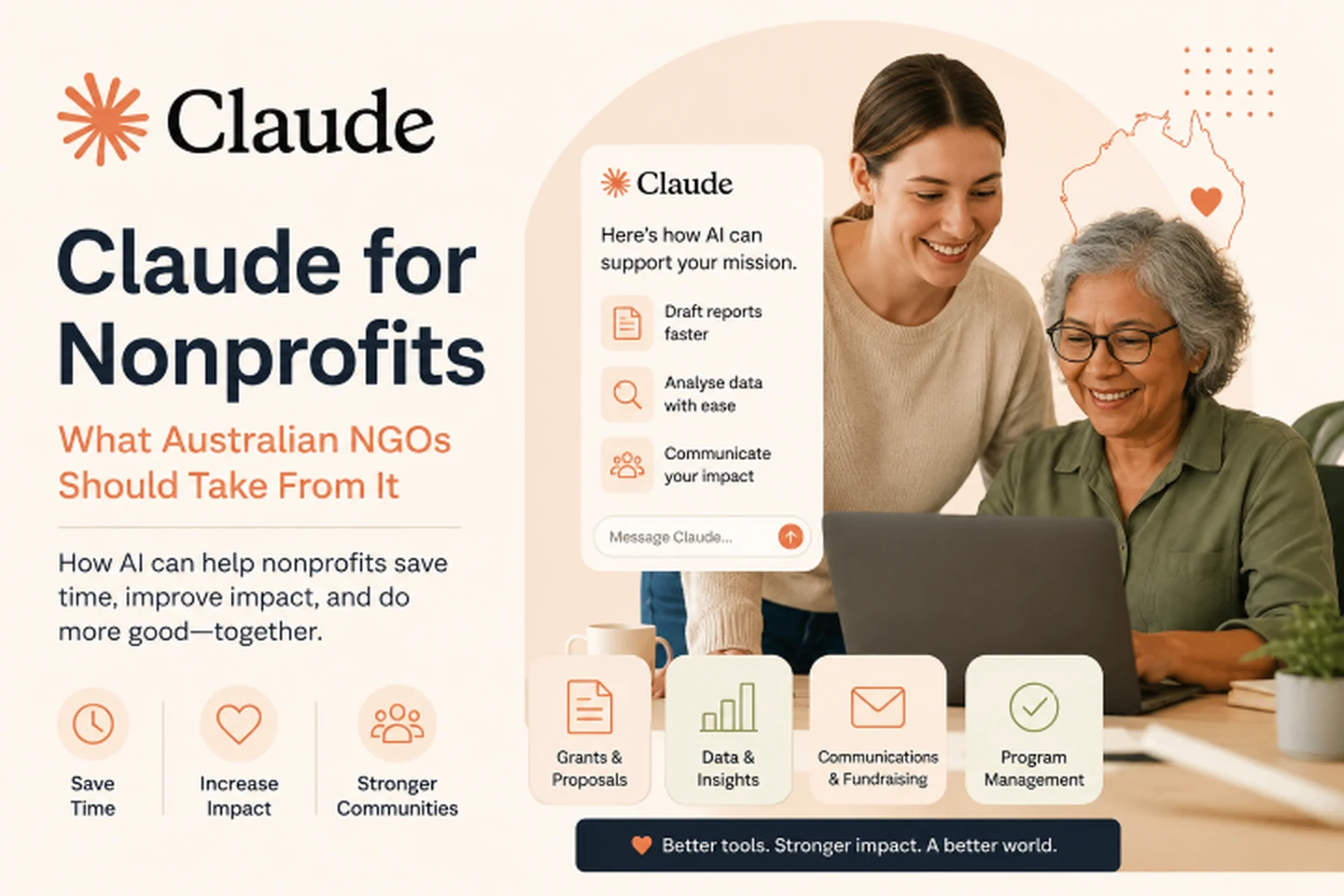
Anthropic now publishes a Claude for nonprofits page with discounted Team and Enterprise plans, connectors into Blackbaud, Benevity and Candid, and a free AI Fluency course for nonprofit staff. Alongside it sits a run of named case studies from World Vision, the International Rescue Committee, World YMCA, IDinsight, MyFriendBen and the Epilepsy Foundation.
It is a good page. It is also a vendor page. The useful question for an Australian NGO is not whether the tool is capable. It is which of these use cases will survive contact with a team of nine people, a shared inbox and a reporting deadline.
Here is how we read those case studies, and what we would want true before starting.
The Claims, Sorted Into Three Honest Buckets
All figures below are Anthropic's, as published on that page. We have not verified them independently. What we have done is group them by how hard they are to reproduce.
Bucket One. Drafting And Summarising
The safest place to start, and the least glamorous.
World Vision reports deploying Claude across strategic finance for lease analysis, reporting, reconciliations and audit summarisation. IDinsight reports drafting documentation five times faster. Robin Hood Foundation describes moving through grant recommendations more efficiently.
What these have in common is that a person who already knows the answer is reviewing the output. The model compresses the writing time, not the judgement. If it produces something wrong, a subject expert catches it in the same sitting.
Almost every Australian NGO has work in this bucket. Grant applications, acquittal narratives, board papers, policy updates, position descriptions, donor thank-you copy. Start here.
Bucket Two. Analysis And Targeting
Higher value, and the point where governance starts to matter.
Clinton Health Access Initiative describes building an interactive geospatial tool in three days rather than weeks, mapping at-risk populations so Guatemala's Ministry of Health could target dengue prevention. MyFriendBen reports agents tracking more than forty benefit programs per state, surfacing over 1.2 billion dollars in value for 70,000 households. IDinsight reports surveys reaching field-ready status sixteen times faster.
These are real, and they are not beginner projects. Every one of them depends on data that was already structured, already owned by someone, and already trusted. The model accelerated the analysis. It did not create the dataset.
If your program data lives in eleven spreadsheets with three different name spellings for the same district, this bucket is blocked. Not by AI capability, by data readiness. That is usually the honest finding when an AI pilot stalls in the sector.
Bucket Three. Beneficiary-Facing Assistants
The Epilepsy Foundation case is the most impressive on the page. An AI companion trained on more than 25,000 pages of epilepsy expertise, available in five languages to 3.4 million Americans.
It is also the worst possible first project. A beneficiary-facing assistant carries clinical or safety risk, needs escalation paths to humans, needs monitoring, needs a content owner and needs a plan for the day it says something wrong to someone in distress. The Epilepsy Foundation built theirs with AWS support and a technology operations executive named on the record. That is the resourcing level the outcome reflects.
Come back to this bucket once buckets one and two are working.
Why The Same Use Case Succeeds In One Organisation And Stalls In Another
Across the AI work we do with humanitarian teams, three things separate the pilots that stick from the ones quietly abandoned after six weeks.
Data readiness. One agreed source for the numbers. Consistent location names. Dates in one format. Without this, analysis use cases produce confident nonsense and staff stop trusting the tool entirely.
One named owner per workflow. Not a committee, and not "the digital team". A person who owns the grant-drafting workflow, keeps the prompt library current and answers questions about it.
A review step someone actually performs. Every AI output that leaves the organisation passes a human who has authority to reject it. If review is nominal, the failure arrives in a donor report rather than a draft.
None of the three requires a licence.
Privacy And Governance For Australian Organisations
A few points worth writing down before any tool touches beneficiary data.
The vendor certifications on that page, SOC 2 Type II, ISO 27001, ISO 42001 and CSA STAR, describe the vendor's controls. They are not a statement about your workflow. Your obligations under the Australian Privacy Principles stay with you regardless of which model you use.
Practical minimums we recommend to clients.
- De-identify beneficiary records before they enter a general-purpose AI tool, unless you have a specific, documented basis not to
- Check consent language. Consent to receive a service is not consent for the data to be processed by a third-party model
- Keep a one-page AI use register. What tool, which workflow, what data class, who owns it, who reviews the output
- Confirm whether your plan trains on your inputs, and record the answer with a date
- Decide the escalation path before, not after, an output causes harm
A register that fits on one page and is actually maintained beats an AI policy nobody reads.
A First Thirty Days That Needs No Budget Approval
You do not need an enterprise agreement to find out whether this helps your team.
- Pick one recurring document. A monthly program report, a standard grant section, a partner update
- Time it honestly. How long does it take today, start to finish, including review
- Run it twice with AI assistance and a named human reviewer. Keep the prompt you used
- Record what changed. Time saved, quality difference, what the reviewer had to correct
- Then decide. Two data points from your own work beat any vendor case study
If step four shows the reviewer rewriting most of it, you have learned something valuable for the price of two afternoons.
Where To Go Next
We built AllyGPT so humanitarian teams could try mode-specific AI assistance on real sector work without a procurement process. The Humanitarian Hub brings live crisis data into one map-first workspace. Our Resources hub collects the vetted external tools and guides we point clients to, including the AI adoption guide.
If measurement is the gap rather than drafting, start with our guide to non-profit KPIs and impact measurement. Better indicators make bucket two possible.
Less admin. More impact. The tooling is finally cheap enough that the constraint is your data and your governance, not the licence.
Related Resources
AllyGPT - AI Assistant
Your AI ally for humanitarian work
Technology Solutions
Make technology work for your mission
Keep reading
About the author
Synergaid supports humanitarian organisations with practical systems, clear processes and honest advice.